New TMT Spotlight Report: Laundering Illegally Caught Fish at Sea
Updated: Sep 1

How illegally caught fish enters global markets long before it reaches port
On the International Day for the Fight Against Illegal, Unreported and Unregulated (IUU) Fishing, TMT is pleased to launch the latest publication in our Spotlight Series.
Illegal fishing is often viewed as a problem that begins and ends on the water. Yet one of the greatest challenges facing fisheries authorities, supply chain actors, and policymakers today is not simply illegal fishing itself, but how illegally caught fish enters legitimate markets.
Our new Spotlight examines an often-overlooked pathway through which illegally caught fish can enter legitimate markets: fish laundering at sea.
A hidden threat to fisheries governance
Fish laundering is the process of disguising illegally caught fish as legal. It typically involves the mixing of illegal and legal catch, transshipment between vessels, vessel identity fraud, mislabelling, and the use of fraudulent documentation.
What makes fish laundering particularly challenging is that it often takes place before fish reaches port. By the time seafood enters a supply chain, the original illegality may already have been concealed.
Once illegally caught fish has been mixed with legal catch, distinguishing between the two can become extremely difficult.. This creates significant risks not only for fisheries management and conservation efforts, but also for seafood traceability, food security, consumer confidence, and legitimate fishing businesses.
Beyond paperwork: how laundering happens at sea
While document fraud in fisheries is well documented, much less attention has been paid to the operational activities that allow illegal catch to be disguised while still at sea.
Drawing on operational intelligence, case analysis, published evidence, and TMT's experience supporting fisheries authorities, the report examines a range of laundering methods that have been identified across multiple fisheries and regions.
These include:
Vessel identity fraud, where multiple vessels operate under the identity of a single authorised vessel.
"Cookie-cutter" fleets, where near-identical vessels can swap identities and licences.
Mislabelling of seafood packaging at sea.
The use of mini-reefers and carrier vessels to conceal the origin of catch.
Certain at-sea fishmeal production and factory vessel operations that can obscure species identity and catch provenance when transparency and controls are inadequate.
Mixing legal and illegal catches in purse seine tuna fisheries.
Documentation fraud and the exploitation of regulatory loopholes surrounding transshipment and port controls.
Many of these methods can occur simultaneously, creating complex laundering networks that are difficult to detect and investigate.
Many of the activities discussed in this report are legitimate and widely used within fisheries operations. The concern arises when they are exploited to conceal the origin, identity, or legality of catch

Why traceability must be complemented by controls at sea
Seafood supply chains have made significant advances in traceability in recent years. However, traceability systems are only as reliable as the information that enters them.
If fish has already been laundered before landing, even sophisticated downstream traceability systems may simply record illegally caught fish as legal.
This reality highlights the importance of addressing risks at the point of harvest and during fishing operations themselves, rather than relying solely on controls further down the supply chain.
An issue that remains largely unmeasured
One of the report's most important findings is that the true scale of fish laundering remains largely unknown.
Because these activities are concealed by design, the number of detected and prosecuted cases is likely to represent only a fraction of total activity. As a result, fisheries authorities and policymakers face a significant evidence gap when assessing risk, allocating resources, and measuring the effectiveness of enforcement efforts.
The report calls for greater efforts to identify, measure, and understand laundering activity, alongside stronger cooperation between flag, coastal, port, and market States.
Practical pathways forward
Despite the challenges, fish laundering is not inevitable.
The Spotlight outlines ten practical actions that governments, regional fisheries bodies, enforcement agencies, and industry can take to reduce laundering risks and strengthen accountability.
These include:
Requiring comprehensive vessel tracking.
Expanding electronic monitoring and observer coverage.
Strengthening port controls and risk-based inspections.
Improving verification of fisheries documentation.
Increasing cooperation and intelligence-sharing between States.
Strengthening seafood supply-chain transparency.
Ensuring penalties outweigh the financial benefits of non-compliance.
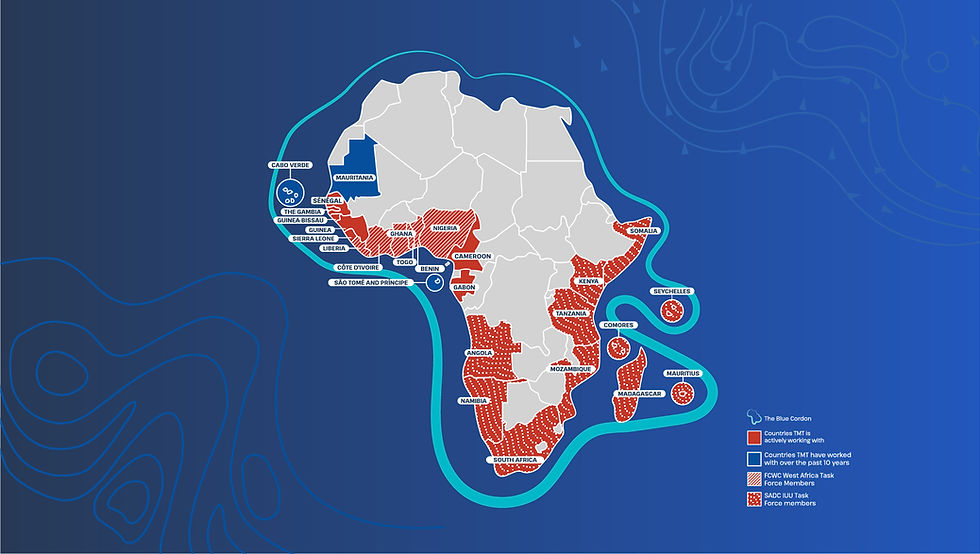
The report also highlights the potential of regional initiatives such as the Blue Cordon and African Vigilance,[LS1.1][GJ1.2] emerging frameworks for cooperation between Africa's fisheries monitoring, control and surveillance centres, which aims to strengthen cooperation between Africa's fisheries monitoring, control and surveillance centres and close the jurisdictional gaps that laundering operations frequently exploit.
Download the report
Fish laundering undermines sustainable fisheries governance, threatens coastal livelihoods, weakens seafood traceability, and enables illegal operators to profit from the exploitation of marine resources.
By shining a light on the methods used to disguise illegally caught fish and identifying practical opportunities for intervention, this Spotlight aims to support authorities and stakeholders working to strengthen transparency and accountability across global fisheries.
Download the full report: Laundering Illegally Caught Fish at Sea
For more information about TMT's Spotlight Series and our work supporting fisheries authorities worldwide, visit www.tm-tracking.org.